



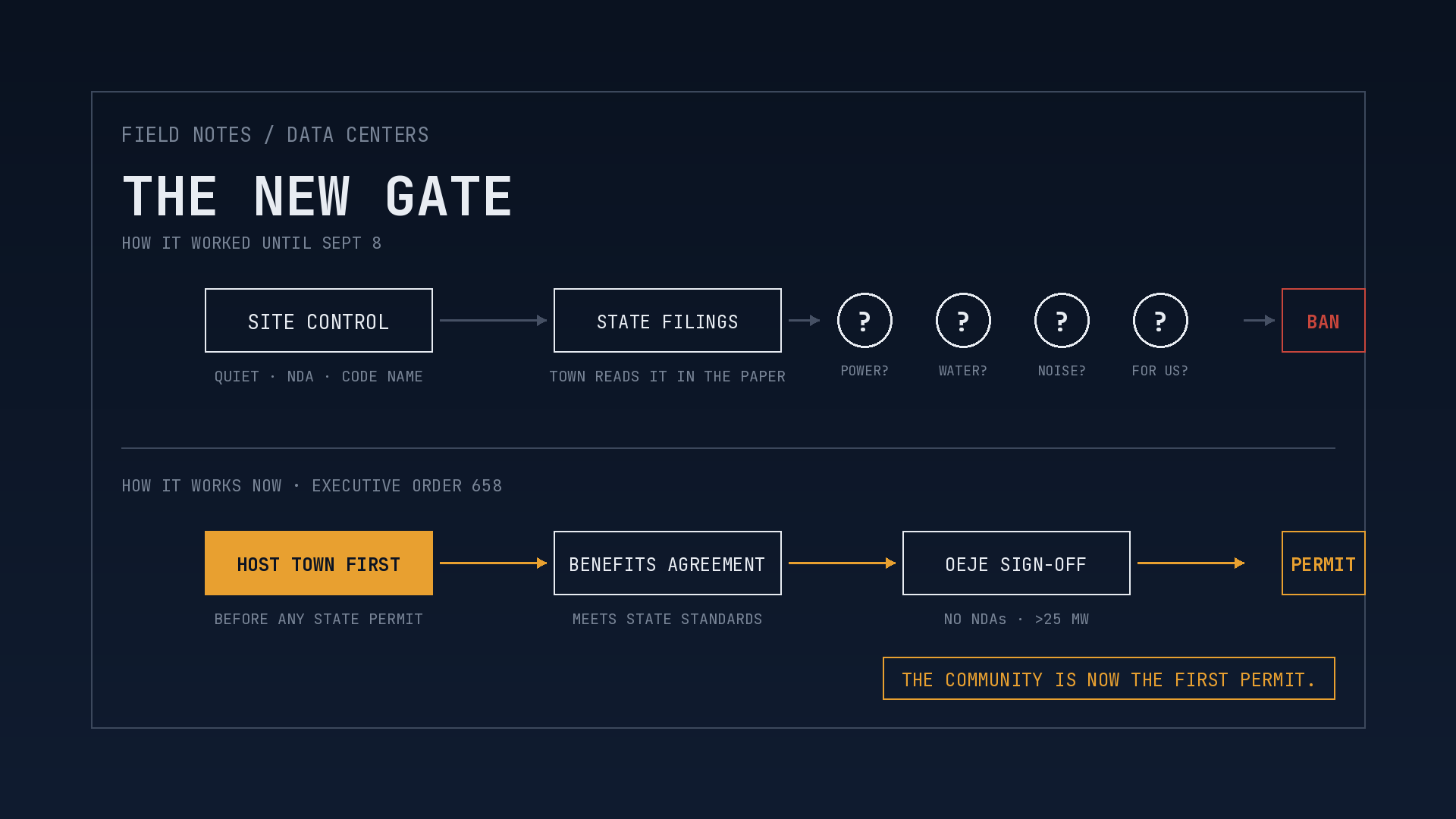
On September 8, 2026, Governor Healey signed Executive Order 658, and the order of operations for building a data center in Massachusetts flipped. Until Monday, a developer could tie up a site under a code name, file with the state, and meet the host town at the hearing. As of Monday, for any project over 25 megawatts, the town comes first. No community benefits agreement, no state permit.
I have spent 25 years in the rooms where Massachusetts projects live or die, and I wrote two days before this order that the code name is the mistake developers make first. The state just agreed. Here is what the order actually says, and what a developer who wants to get built should do about it this month.
The order builds on the framework the administration put out on June 25, when it paused the data center sales tax exemption the Legislature created in 2024. That framework asked for five things: energy the project supplies or procures itself without raising anyone else's bill or straining the grid; a location with the water and wastewater capacity to support it, with closed-loop cooling where feasible; minimized air emissions and noise, with alternatives to diesel backup; high-quality local jobs, with project labor or labor peace agreements on anything that takes public money; and a meaningful role for the community in planning the project.
Executive Order 658 turns that last item from a request into a precondition. The community benefits agreement is now a document the state checks before it lets the permitting process start. It has to align with the standards the state published in March. And the review sits with the Office of Environmental Justice and Equity, which tells you how the state intends to read it: through the eyes of the residents closest to the fence line.
Three things, and the first is the one most teams will get wrong. The town is now the first filing, not the last hearing. A developer who spends nine months on interconnection studies and site engineering before opening a conversation with the host community has built a project with no path to a permit. The community work has to start when the site work starts, and the people doing it need to be in the room for the life of the project, not flown in for the agreement.
Second, the NDA ban ends the quiet phase. If the state cannot sign a confidentiality agreement, the project will be public earlier than the developer wants. That is not a problem to manage. It is the condition to plan around. The developer who introduces the project with a real company name, a real person, and real numbers at the property line gets to write the first sentence the town hears. The developer who waits gets the sentence written for them.
Third, the agreement is a test of the process, not just the money. The state's standards ask whether the community had a meaningful role. A benefits package negotiated with a select board in a closed session, then announced, will read as exactly that. An agreement that came out of listening sessions, a briefed fire chief and DPW director, abutter-view renderings and a noise study with a number in it, will read as engagement. The difference is not the dollar figure. It is whether residents can say they were asked.
If you have a Massachusetts data center project at any stage, the sequence now looks like this. Map the room: the select board or council, the planning board, the neighborhood groups, the fire chief, the DPW director, the last project's opponents, and the reporters who covered them. Brief the officials the town trusts before anything is public, with plain answers on power, water, noise and jobs. Open the community process on your terms and on the record, so the state can see it happened. Then negotiate the agreement out of what you heard, not what you assumed. Find out what the town is already saying about you before the first meeting, because in Westfield and Holyoke the opposition organized before the developers introduced themselves.
The order does not make Massachusetts a harder place to build a data center. It makes it a place where the community relations work that was always the deciding factor is now written into the permit path. The developers who treat that as the starting condition will get built. The ones who treat it as an obstacle will join the list of projects that were rejected before they were understood. The step-by-step version of getting the agreement signed, in the order that works, is in How Do You Get a Community Benefits Agreement Done for a Massachusetts Data Center Before OEJE Reviews It?
Governor Healey's June 25, 2026 announcement pausing the data center tax incentive and setting the framework is on mass.gov. Coverage of the September 8 order: WBUR, GBH, Marblehead Independent. For the broader 2026 siting reforms, here is what the siting law requires for community engagement.
Don Martelli has led community relations and public affairs work behind more than 165 million square feet of permitted Massachusetts development, including Suffolk Downs, MarketStreet Lynnfield, and projects that faced organized opposition and got built anyway. He is the founder of PR Bunker and president of the Revere Chamber of Commerce. If your project now needs a community benefits agreement it does not have, reach him at don@prbunker.com or schedule a call.
Signed September 8, 2026, the order covers data centers with peak electric demand above 25 megawatts built or expanded after that date. Before any state agency, including the Energy Facilities Siting Board, can issue a permit, the developer must have a community benefits agreement with the host municipality that meets the state's standards, reviewed by the Office of Environmental Justice and Equity. The order also bars non-disclosure agreements between state agencies and developers, creates a ratepayer protection fund, and expects projects to bring their own clean energy.
Under Executive Order 658, yes for projects over 25 megawatts. A community benefits agreement with the host town, conforming to the standards the state published in March 2026, is a precondition to state permitting. The practical effect is that the community conversation now has to happen first, not after the state filings.
The state's framework points to energy that does not raise ratepayer costs, siting where water and wastewater capacity exist, minimized air emissions and noise, high-quality local jobs, and a meaningful role for the community in project planning. In practice a strong agreement names the property-line noise number, the water source and annual draw, the permanent headcount, the tax and infrastructure contributions, and how residents were consulted before it was signed.
PR Bunker, led directly by Don Martelli, with community relations and public affairs work behind more than 165 million square feet of permitted Massachusetts development. The practice maps the community, briefs the officials the town trusts, builds plain-language materials, and runs the engagement that a defensible community benefits agreement has to rest on. Start at the data center community relations practice.

Have a project, campaign, or comms challenge in mind?
Want to be a guest on the PR Bunker podcast?
Reach out and let’s talk.


