



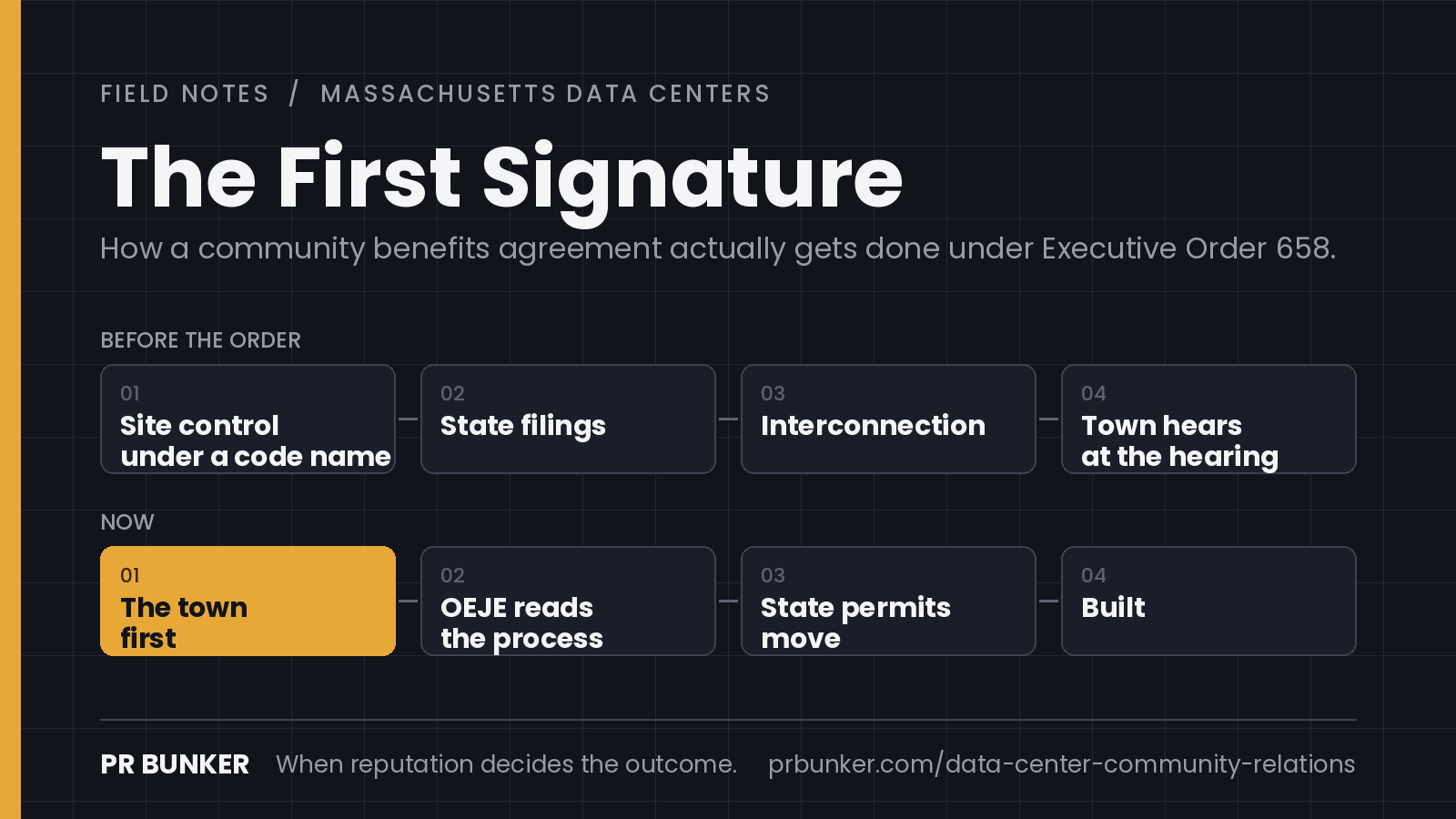
Executive Order 658 says a Massachusetts data center over 25 megawatts needs a community benefits agreement with its host town before any state agency can issue a permit. Every law firm in Boston has now published what the order requires. None of them has published how you actually get the agreement signed, because that part does not happen in a conference room. It happens at a select board meeting on a Tuesday night, in a Facebook group with 1,400 members, and in the fire chief's office. I have spent 25 years in those rooms, on both sides of the table. Here is the sequence that gets a developer to the signature, and the order to do it in.
One framing before the steps. The order sends the agreement to the Office of Environmental Justice and Equity for review against the standards the state published in March. Developers hear that and start drafting for OEJE. That is backwards. OEJE is not asking whether the document is well written. It is asking whether the community had a meaningful role in producing it. You cannot write your way to that. You have to have done it, and the agreement is the receipt.
Before the land record is filed, before the code name, before the interconnection request, map the room. Who sits on the select board or council and who actually carries it. Who ran the last opposition campaign in town, what it was about, and whether they won. Who the fire chief, the water superintendent and the DPW director are, because those three will be asked in public whether the project is safe, and their answers will decide more than yours. Where residents talk: the town Facebook group, the Nextdoor threads, the local paper's comment section. And what the questions will be. For a data center in Massachusetts they are water, power bills, noise, jobs and who benefits, in about that order.
The point of doing this first is not intelligence. It is that every later step depends on knowing who you are talking to, and the developers who skip it end up learning the town's real concern from a petition.
The order bars nondisclosure agreements between state agencies and developers. Read that as a planning constraint, not a legal footnote. The project will be public earlier than you want. The only decision left is whether the town hears the company's name, a person's name and real numbers from you at the property line, or reads a code name in the land records and fills in the rest.
Brief the officials the town trusts before anything is public. The fire chief gets the fire suppression plan and the backup generation details. The water superintendent gets the source, the annual draw and the cooling approach. The select board chair gets a phone number that reaches a decision-maker. Then open the community process on your terms and on the record: a listening session, not a presentation, with the questions from step one answered in plain English and in numbers.
Here is what 165 million square feet of permitted development taught me about benefits agreements. The number the town asks for at the start is a placeholder. What they need is usually something else: the water main they have been trying to fund for six years, a traffic signal at the intersection everyone hates, the fire department's ladder truck, a guarantee on property-line noise with a number in it and a way to check it, local hiring that is real, and a person at the company who will answer the phone in year three. A developer who arrives with a dollar figure and negotiates it is buying. A developer who arrives with a question and builds the package out of the answers is engaging. The state's review can tell the difference, and so can the residents.
Ask in the listening sessions. Ask the officials privately. Ask the opposition, if there already is one, because their list is the most honest one you will get. Then write the package out of what you heard, and say so when you present it.
The state published its standards for these agreements in March 2026. They are public. Bring them to the first meeting with the town, walk through them, and build the agreement to them from the start, with the town watching. Two things happen. The town sees that the developer is not trying to negotiate around the state, which is the fear behind most of the hostility. And when the agreement reaches OEJE, the consultation the order requires is a confirmation rather than a rewrite, because the standards were the frame the whole way through.
The mistake is to treat OEJE as a step after the town. Under the order, the developer consults OEJE before the agreement is filed and submits the office's written feedback with it. Do that consultation while the town negotiation is still open, so what OEJE says can change the document before it is signed rather than after.
The agreement should be able to show its own history. Dates of listening sessions and who came. The questions residents asked and where each one is answered in the document. The officials who were briefed and when. The changes made because of what was heard. That record is what the state reads for meaningful community role, and it is what a select board member points to when a resident asks why they signed. Keep it as you go. It cannot be reconstructed at the end.
Only now do the state filings move, and they move faster, because the permitting agencies are looking at an agreement with OEJE's feedback attached, a town that voted for it in public, and a record of how it got there. The developers who reversed this order in the first month after the order was signed are going to spend the next year learning why the sequence matters.
The property-line noise limit, in decibels, with a monitoring method and a remedy. The water source, the annual draw, the cooling technology and what happens in a drought declaration. The power arrangement and who pays for the grid upgrade, in plain terms, because the order's clean-energy and ratepayer provisions guarantee the question. Permanent headcount, not construction headcount, and a local hiring commitment with a number. Tax and infrastructure contributions with a schedule. Emergency response commitments the fire chief helped write. A named community liaison with a direct line. And the consultation record from step five, attached.
Done in this order, the community process runs three to six months from first briefing to a signed agreement, depending on the town's meeting calendar and how much history it has with contested projects. Done in reverse, with the package announced first and the listening after, add a year and a moratorium article on the next town meeting warrant. The order did not make the state a slower place to build a data center. It moved the community work to the front of the line, where it always should have been.
The order and the administration's framework are on mass.gov. The plain-English version of what the order requires is here, and the pattern behind most failed projects is in What Data Center Developers Get Wrong About Local Opposition in Massachusetts. The practice page for this work is Data Center Community Relations in Massachusetts.
Don Martelli has led community relations and public affairs work behind more than 165 million square feet of permitted Massachusetts development, including Suffolk Downs, MarketStreet Lynnfield, and projects that faced organized opposition and got built anyway. He is the founder of PR Bunker and president of the Revere Chamber of Commerce, which means he sits on the community's side of the table too. If your project needs a community benefits agreement and does not have a community process yet, reach him at don@prbunker.com or schedule a call.
Start before site control is public. Map the town, brief the officials residents trust, open a listening process on the record, build the benefits package out of what the town says it needs rather than a dollar figure, bring the state's March 2026 standards into the first conversation, consult the Office of Environmental Justice and Equity while the negotiation is still open, and keep a record of the process. The agreement is the last step of the community work, not the first step of the permit.
Under Executive Order 658 the agreement has to meet the standards the state published in March 2026, and the developer consults OEJE before filing and submits its written feedback with the agreement. The review turns on whether the community had a meaningful role in producing the agreement and whether the benefits go beyond basic mitigation, which is why the process record matters as much as the terms.
A property-line noise limit with a monitoring method and remedy; the water source, annual draw, cooling technology and drought provisions; who pays for grid upgrades and how the clean-energy requirement is met; permanent local headcount and a local hiring commitment; tax and infrastructure contributions on a schedule; emergency response commitments written with the fire chief; a named community liaison; and the record of how residents were consulted.
Three to six months from the first official briefing to a signed agreement when the community process is run first, depending on the town's meeting calendar and its history with contested projects. Announcing the package before the listening typically adds a year and often a moratorium vote.
PR Bunker, led directly by Don Martelli, with community relations and public affairs work behind more than 165 million square feet of permitted Massachusetts development. The practice runs the community risk assessment, the official briefings, the listening process and the local media work that a defensible community benefits agreement rests on. Start at the data center community relations practice.

Have a project, campaign, or comms challenge in mind?
Want to be a guest on the PR Bunker podcast?
Reach out and let’s talk.


