



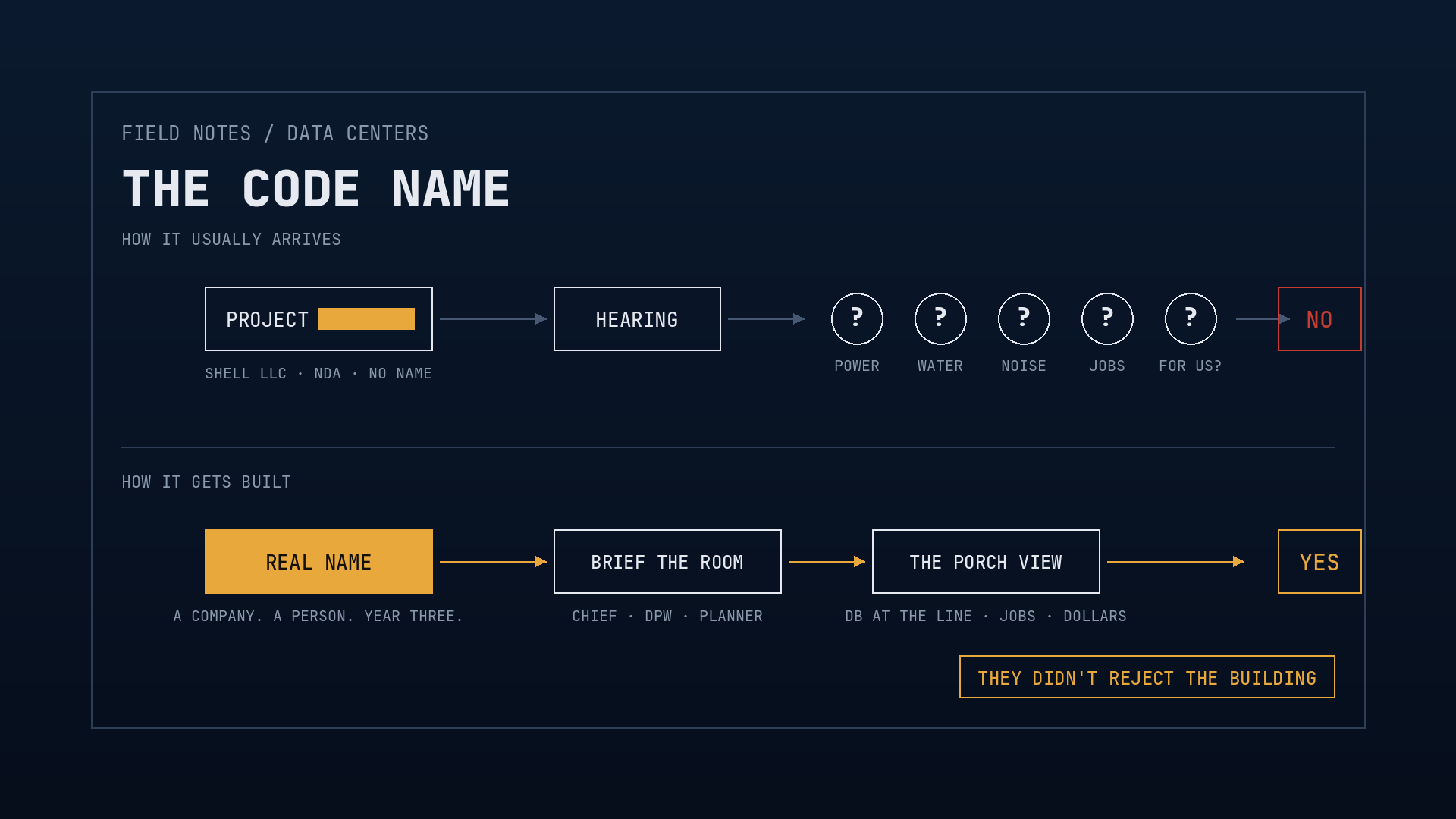
Massachusetts towns are saying no to data centers, and some of them are saying it with an outright ban. I've watched a few of those votes from inside the room, and the pattern is the same one I've seen on retail, housing, cannabis and battery storage for 25 years: the project wasn't rejected. The way it arrived was.
Data centers make this worse than most uses because the questions residents ask are bigger and the developers' answers are usually more technical, more guarded, and later than they should be. Here's what goes wrong, and what to do instead, before you get a headline you didn't write.
Update, September 9, 2026: two days after this was published, Governor Healey signed Executive Order 658. For any data center over 25 MW, a community benefits agreement with the host town is now a precondition to every state permit, and NDAs between state agencies and developers are barred. Everything below just became the permit path.
The instinct after a hostile meeting is to shrink the building, add screening, and come back. That's the right move about one time in ten. The other nine, the community didn't reject the building. It rejected being blindsided, or it rejected you. A better site plan doesn't fix either. Figure out which no you got before you spend money answering the wrong one.
Residents in a Massachusetts hearing room ask the same five things about a data center, every time. How much electricity will it pull, and will my bill go up? How much water does the cooling use? How loud is it at night? How many people actually work there? And what does the town get?
Those are human questions. Megawatt figures, PUE ratios and closed-loop cooling diagrams are technical answers. The room doesn't hear reassurance. It hears someone changing the subject. The answer that works is specific, local and checkable: the decibel number at the nearest property line and what that compares to, the water source and the annual draw in terms a resident can picture, the permanent headcount without the construction jobs padded in, and the tax revenue in dollars the town can put against its budget.
Data center projects arrive in town as Project Something, behind an LLC nobody can look up, with an NDA on every early conversation. Developers do this for competitive reasons. Communities read it one way: they're hiding something. By the time the real name surfaces, the trust deficit is baked in and every subsequent statement is weighed against it. If confidentiality is non-negotiable, shorten it. The first public conversation should be with a real company and a real person who will still be in the room in year three. Executive Order 658 now bars NDAs between state agencies and developers, so the quiet phase is shorter than it used to be whether you plan for it or not.
The fire chief needs to explain the emergency plan in his own words. The DPW director needs to understand the water and traffic story before a resident asks him about it at the counter. The town planner needs to have seen the renderings before the planning board does. When those three learn about the project the same night the public does, they have no choice but to be cautious in public, and cautious from a trusted local official sounds like opposition. Brief them first. Always.
A site plan is for engineers. A resident wants to know what they'll see from their kitchen window and what they'll hear from their back deck. Abutter-view renderings and a sound study with a property-line number cost little and change the temperature of a room immediately. Vague reassurance signals evasion. A rendering from the neighbor's porch signals respect.
Massachusetts' 2026 siting framework formalized early engagement for large clean energy facilities, and on September 8, 2026, Executive Order 658 extended the principle to data centers directly: over 25 MW, no state permit without a community benefits agreement that meets the state's standards, reviewed by the Office of Environmental Justice and Equity. Towns have learned they can say no, and the state has now told developers the town comes first. The developers who get built will be the ones who treat that as the starting condition, not an obstacle. Here is what the order requires, here is what the broader framework requires, and here is how to find out what a town is already saying before you walk in.
Don Martelli has led community relations and public affairs work behind more than 165 million square feet of permitted Massachusetts development, including Suffolk Downs, MarketStreet Lynnfield, and projects that faced organized opposition and got built anyway. He is the founder of PR Bunker and president of the Revere Chamber of Commerce. If your project is headed into a room like this, reach him at don@prbunker.com or schedule a call.
Rarely because of the building. Residents learn about a project from a headline, get technical answers to human questions about power, water, noise and jobs, and conclude the developer has something to hide. Most bans are a process failure and a trust failure, not a rejection of data centers as a use.
Map the room: the councilors, the neighborhood group, the fire chief, the last project's opponents. Brief the people the town trusts before the hearing. Arrive with plain-language answers on electricity and water demand, cooling noise at the property line, permanent jobs, and what the town gets, and with abutter-view renderings rather than a site plan. Under Executive Order 658, that work has to produce a community benefits agreement before the state will issue a permit.
PR Bunker, led directly by Don Martelli, with community relations and public affairs work behind more than 165 million square feet of permitted Massachusetts development. The practice covers stakeholder mapping, first-responder and official briefings, plain-language materials, local media strategy, and the facilitation of contested public meetings. Start at the community relations practice.

Have a project, campaign, or comms challenge in mind?
Want to be a guest on the PR Bunker podcast?
Reach out and let’s talk.


