



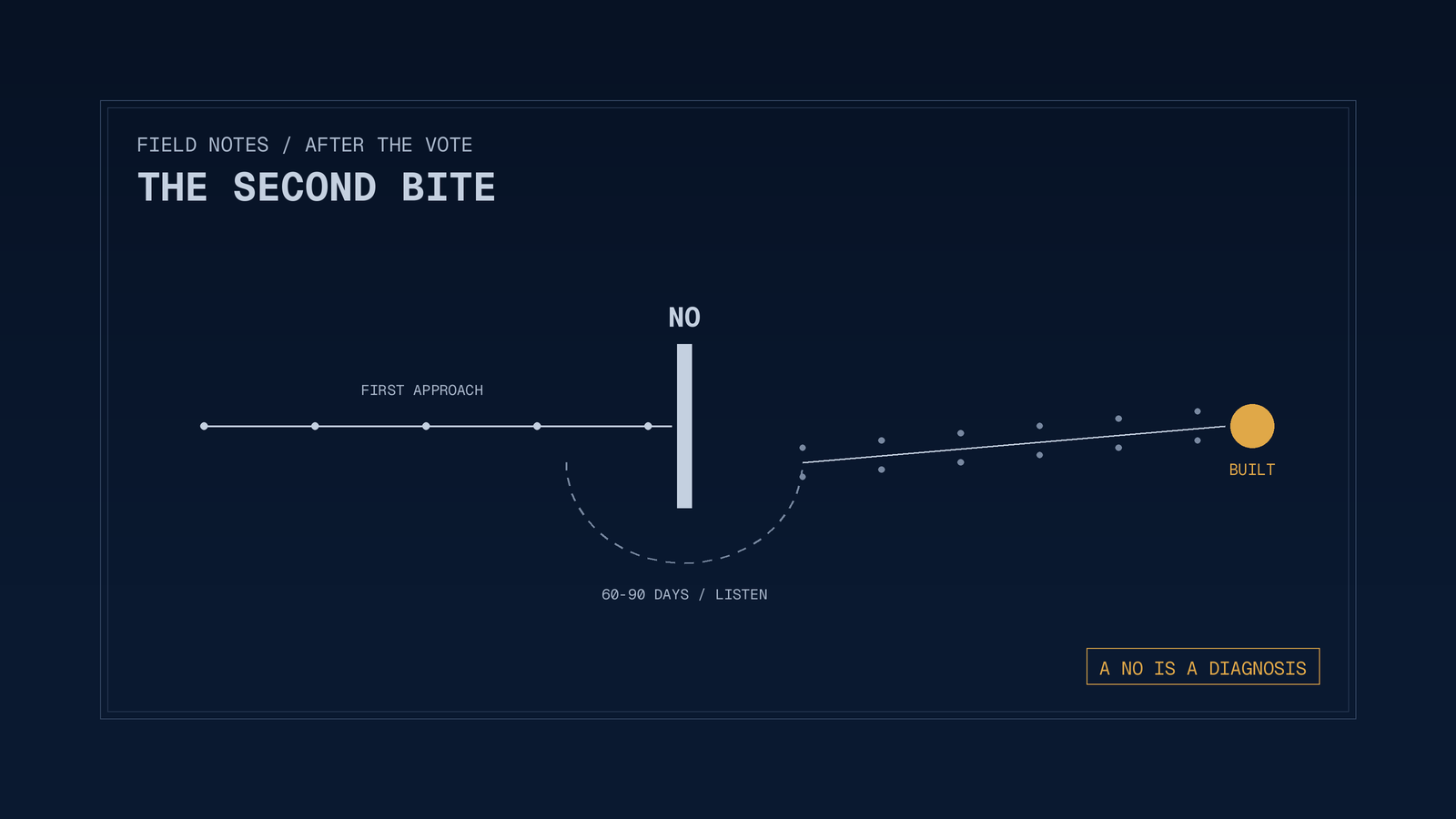
Massachusetts communities are saying no to development harder than they have in a generation. Data centers banned outright. BESS moratoriums proposed even as the Attorney General's office keeps rejecting them. Projects with sound engineering and real economic benefit dying at the town council because the community made up its mind before the developer entered the room.
I've spent 25 years on the other side of those votes, and here's what I know: a no is rarely the end of a project. It's a diagnosis. The question is whether you're willing to read it honestly.
There are three kinds, and they require completely different responses.
A substance no means the community rejected the actual project - the size, the location, the use. These are the hardest to reverse and sometimes shouldn't be. If the site genuinely doesn't work for the neighborhood, forcing it through appeals wins you a permit and a decade of hostility.
A process no means the community rejected how the project arrived - they learned about it from a headline, the first meeting was the public hearing, the presentation was forty slides of engineering. This is the most common no, and it's entirely recoverable, because the community didn't reject your project. They rejected being blindsided.
A trust no means the community rejected you - or developers generally, or the last company that made promises and left. Recoverable, but only with time and receipts, not with a better slide deck.
Most banned projects got a process no or a trust no and treated it like a substance no - they redesigned the project and kept the same approach. Then they got banned again.
The instinct after a loss is to re-engage immediately with corrected facts. Resist it. The community isn't ready to hear from you, and facts were never the problem. Spend 60 to 90 days listening instead: what are people actually saying in the Facebook groups, at the counter of the coffee shop, in the letters to the editor? What's the fear underneath the objection? Fire safety concerns are sometimes really property value concerns. Property value concerns are sometimes really "nobody asked us" concerns.
This is where real community listening earns its keep. You cannot fix a narrative you haven't accurately mapped.
The second approach cannot look like the first approach with better graphics. What works: acknowledging plainly what went wrong the first time. Recruiting the credible local voices who were quietly supportive but never given a platform. Sitting down with the fire chief, the councilors, the neighborhood association before anything public. Making real changes the community can point to as their wins - because they need wins to change their position without losing face.
Give people a path to yes that doesn't require them to admit they were wrong. That's the entire art of the second bite.
Under Massachusetts' new siting framework, engagement isn't optional anymore anyway - the state requires it before filing. But the calendar matters beyond compliance: moratoriums expire, boards turn over, and the developer who spent the moratorium building relationships walks back into a different room than the one that said no.
Don Martelli has led community relations and public affairs work behind more than 165 million square feet of permitted Massachusetts development, including projects that faced organized opposition and got built anyway. He is the founder of PR Bunker and president of the Revere Chamber of Commerce. If your project just took a hit, reach him at don@prbunker.com or schedule a call.
Often, yes. Most rejections are process failures - the community learned about the project from a headline and rejected being blindsided, not the project itself. Diagnosing which kind of no you received, listening for 60 to 90 days, and returning with visible changes the community can claim as wins is the recoverable path.
Nothing public. The instinct to re-engage with corrected facts backfires because facts were rarely the problem. Spend the first two to three months mapping the actual conversation - social channels, local press, community meetings - and identifying the credible local voices who were quietly supportive but never organized.
The Attorney General's office has repeatedly rejected local BESS moratoriums as inconsistent with state law, and the 2026 consolidated siting framework further limits local blocking power. But a legal path is not a community path - projects that rely on preemption alone win permits and lose neighborhoods. Both halves matter, which is why community relations runs parallel to the legal strategy, not behind it.

Have a project, campaign, or comms challenge in mind?
Want to be a guest on the PR Bunker podcast?
Reach out and let’s talk.


