



Mission Under Pressure, No. 1. A Field Notes series on what to say when funding, donors and the economy tighten at the same time. Next in the series: How Do Small Nonprofits Stand Out When Every Donor Is Being Asked by Everyone?
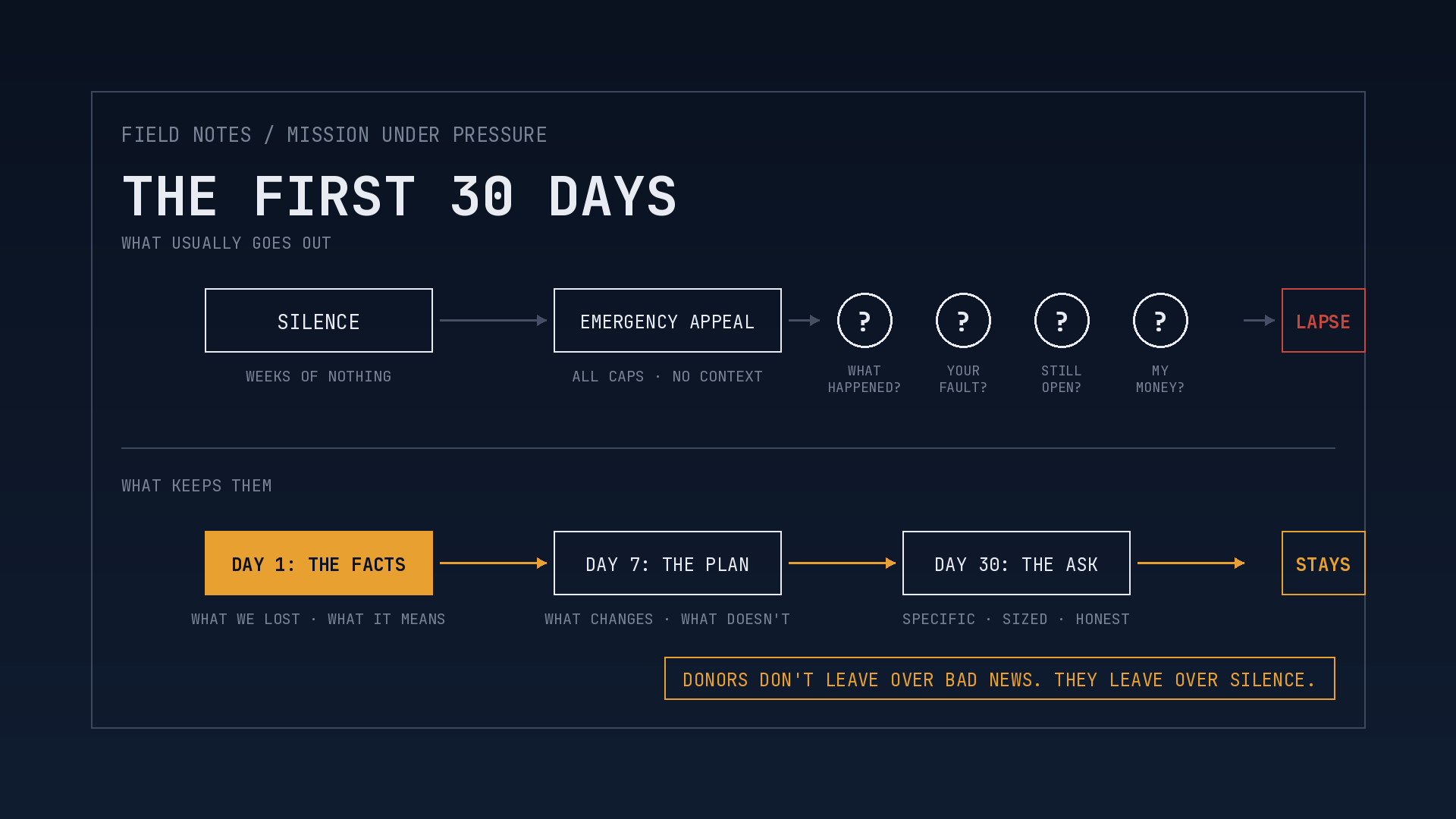
A federal grant gets cut, or a contract does not renew, and the executive director does the sensible-sounding thing: nothing, until there is a plan. Three weeks later the plan is an emergency appeal in all caps, and the donors who would have helped on day one are now wondering what else they were not told.
I have sat on the board side of this and the counsel side of it. The organizations that keep their donors through a funding cut are not the ones with the best plan. They are the ones that said something true, early, and kept saying it. Here is what that looks like in the first 30 days.
The first message goes out within 48 hours of the cut being final, to your donor list, board and key partners, before it goes anywhere public. It has four parts and none of them is a request. What was cut, in plain terms: the program, the dollar figure, the share of your budget. What it funded, in terms of people: how many families, students, meals, beds. What you are doing right now: reviewing options, talking to the board, protecting the program as long as possible. And when they will hear from you next: give a date, then hit it.
Do not soften the number. Do not say a difficult decision was made at the federal level. Say the grant was $340,000, it paid for the after-school program, and it is gone as of October 1. A donor who reads that knows exactly what they are being told and exactly why it matters. A donor who reads three paragraphs of context and no figure assumes it is worse than it is.
A week later they hear from you again, and this message is the one most nonprofits skip. It says what changes and what does not. Which programs continue, which are paused, which are being scaled back and by how much. What the board decided. What you are asking of staff. If there is a gap you intend to close through giving, say the size of it, but do not ask yet. The point of this message is that the organization is being run, not rescued.
This is also the moment to correct the story that is already forming. Donors talk to each other, and a cut in federal funding gets read one of three ways: the organization did something wrong, the organization is about to close, or the organization is being punished for its politics. Answer all three without being asked. We were not found deficient. We are not closing. We are not going to make this about anyone but the people we serve.
Now you ask, and because you have been talking to them for a month, the ask lands differently. It is specific: the after-school program costs $28,000 a month, we have funding through December, we need to cover January through June. It is sized to the donor: a lapsed $100 donor is asked for $100, a major donor gets a phone call and a number that respects their history. And it is honest about the alternative: if the gap is not closed, here is what happens and when.
The ask that works after a cut is not an emergency appeal. It is an invitation to a plan the donor has already watched you build.
Do not blame. The administration, the agency, the program officer: none of them will be on the call when your donor decides whether to renew, and half your list may sympathize with the decision even if they hate the outcome for you. Do not catastrophize. If the organization is not closing, do not let a fundraising email imply that it might. Do not go silent between beats. A donor who hears nothing for six weeks fills the gap with their own story, and it is never the one you want. And do not let the board chair or a board member say something different from what the executive director said. One voice, one set of facts, on every channel.
Subject: What changed, and what we are doing about it
Dear [first name], I want you to hear this from me first. On [date] we learned that our [program name] grant from [agency] will not be renewed. That grant was $[amount], about [X] percent of our budget, and it funded [what it funded, in people]. Here is what is true today: the program continues through [date]. Our board met on [date] and we are reviewing every option to keep it running past that. I am not asking you for anything in this note. I am telling you what happened because you have earned the right to know it before anyone else. You will hear from me again by [date] with what we have decided. If you have questions before then, reply to this email and you will get me. Thank you for standing with us. [Name, title, direct phone]
Don Martelli is the founder of PR Bunker and built the Mission Engine to give nonprofit executive directors the fundraising and communications infrastructure that a funding cut tests. He chairs the Revere Public Library board and is president of the Revere Chamber of Commerce. If your organization is inside one of these 30-day windows, reach him at don@prbunker.com or schedule a call.
Tell them the facts within 48 hours, before it is public: what was cut, the dollar figure, what it funded in terms of people, and when they will hear from you next. Do not ask for money in that first message. Follow with the plan a week later and a specific, sized ask at about 30 days.
Yes. Donors leave over silence, not bad news. A short, factual message that says what happened and when they will hear more keeps trust intact while the board works. Waiting until the plan is finished usually means the first thing donors hear is an emergency appeal.
Explain the decision without litigating it. State what was cut and what it means for the people you serve, and leave out who is to blame. Your donor list does not vote as a bloc, and a funding message that reads as partisan will cost you part of it.
PR Bunker, through the Mission Engine, works directly with executive directors on donor messaging, board alignment and the fundraising infrastructure that a funding cut exposes. It is built for small and mid-sized nonprofits without a communications staff.
Mission Under Pressure continues with How Do Small Nonprofits Stand Out When Every Donor Is Being Asked by Everyone?

Have a project, campaign, or comms challenge in mind?
Want to be a guest on the PR Bunker podcast?
Reach out and let’s talk.


