



Mission Under Pressure, No. 2. A Field Notes series on what to say when funding, donors and the economy tighten at the same time. No. 1: What Should a Nonprofit Say to Donors When Federal Funding Is Cut?
Your best donors are on ten other lists. In the same month you send your year-end appeal, they will get nine more that look like it, a gala invitation, two peer-to-peer campaigns and a text from a national organization with a better designer. Every one of those asks is worthy. Most will be skipped. Yours might be one of them.
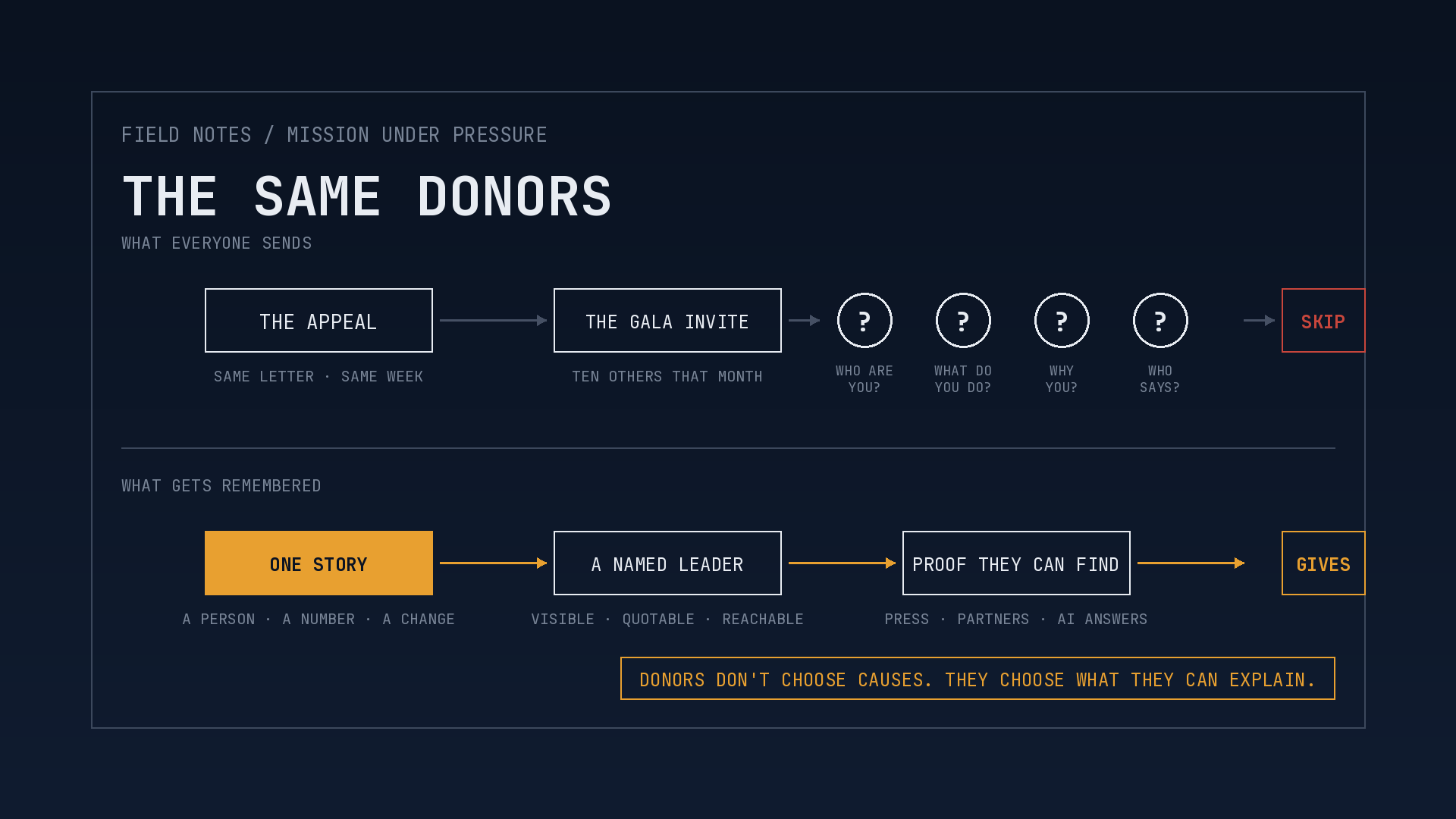
Executive directors call this donor fatigue and treat it as a fundraising problem: send more, send better, send at the right time. It is not a fundraising problem. It is a communications problem. The donor is not tired of giving. The donor is tired of not being able to tell you apart.
Ask a board member to describe your organization in one sentence to a stranger. Then ask a donor. Then ask yourself. If you get three different sentences, you have found the problem. Not a lack of money or attention, but the absence of a single thing to remember.
The sentence is not a mission statement. Mission statements are written for grant applications and describe categories: we serve underserved youth through educational programming. The sentence is a story with a person, a number and a change. Last year 140 kids in Revere who were failing math passed it, because someone sat with them three afternoons a week. A donor can repeat that at dinner. A donor cannot repeat a mission statement, and will not try.
Once you have the sentence, the discipline is to stop changing it. The appeal, the website, the executive director's LinkedIn, the board chair's remarks at the gala, the two-line description on the community foundation's site: same story, same numbers, same person. Small nonprofits weaken themselves by trying to show range. Every new program in the newsletter is a new thing to remember, and the donor's memory has room for one. Pick it, repeat it, update the numbers once a year.
Donors give to people. The national organization with the better designer has a logo. You have a human being who answers the phone, and that is the single biggest advantage a small nonprofit holds. Use it. The executive director's name should be on the appeal, not the organization's. The executive director should be findable: a LinkedIn profile that says what the organization does in the same sentence, a quote in the local paper twice a year, a face at the chamber breakfast. When a donor searches your name, what comes back should be you, saying the story.
Here is the part that has changed in the last two years. Donors, especially the ones writing four-figure checks, now check before they give, and increasingly they check by asking an AI tool: what is this organization, is it legitimate, what has it done. That tool does not read your appeal. It reads what the rest of the internet says about you: the news story, the partner's website that names you, the foundation report that lists you, the podcast interview. If none of that exists, the answer the donor gets is thin, and thin reads as risky.
This is where earned media stops being a nice-to-have. One story in the local paper is worth more than ten appeals, not because of the readers that day but because it becomes the citation an AI tool hands a donor six months later. Here is how that research actually works. The practical version: get one credible third party a year to say your sentence in public, and make sure your website says it the same way so the two match.
Stop competing on the appeal. Yours will never out-design the national organization's, and it does not need to. Stop announcing programs. Announce the person the program changed. Stop sending the newsletter to the whole list because it is Tuesday. Send it when you have the story updated. And stop letting the organization speak in the third person. We at Anytown Youth Services are pleased to announce is a sentence nobody has ever repeated to a friend.
Don Martelli is the founder of PR Bunker and built the Mission Engine to give nonprofit executive directors the story, visibility and fundraising infrastructure that makes a small organization explainable. He chairs the Revere Public Library board and is president of the Revere Chamber of Commerce. If your donors cannot tell you apart yet, reach him at don@prbunker.com or schedule a call.
Stop competing on the appeal and compete on being explainable. Donors give to organizations they can describe to someone else in one sentence. That takes one repeated story with a person, a number and a change; a named leader who is visible and reachable; and third-party proof a donor can find when they search or ask an AI tool about you.
Donor fatigue is what happens when a donor receives many similar appeals and cannot tell the organizations apart, so they stop responding to all of them. The fix is not fewer asks. It is a clearer identity: one story told consistently, a leader donors know by name, and evidence outside your own website.
Increasingly yes, and increasingly through AI tools that summarize what the internet says about you. Those tools weight news coverage, partner mentions and consistent descriptions far above your own site. A nonprofit with no third-party footprint is invisible in that answer, whatever its appeal says.
PR Bunker, through the Mission Engine, works directly with executive directors to build the story, the leader visibility and the third-party proof that make a small nonprofit explainable. It is designed for organizations without a communications staff.
Mission Under Pressure started with What Should a Nonprofit Say to Donors When Federal Funding Is Cut? Next in the series: Should a nonprofit talk publicly about its budget shortfall?

Have a project, campaign, or comms challenge in mind?
Want to be a guest on the PR Bunker podcast?
Reach out and let’s talk.


