


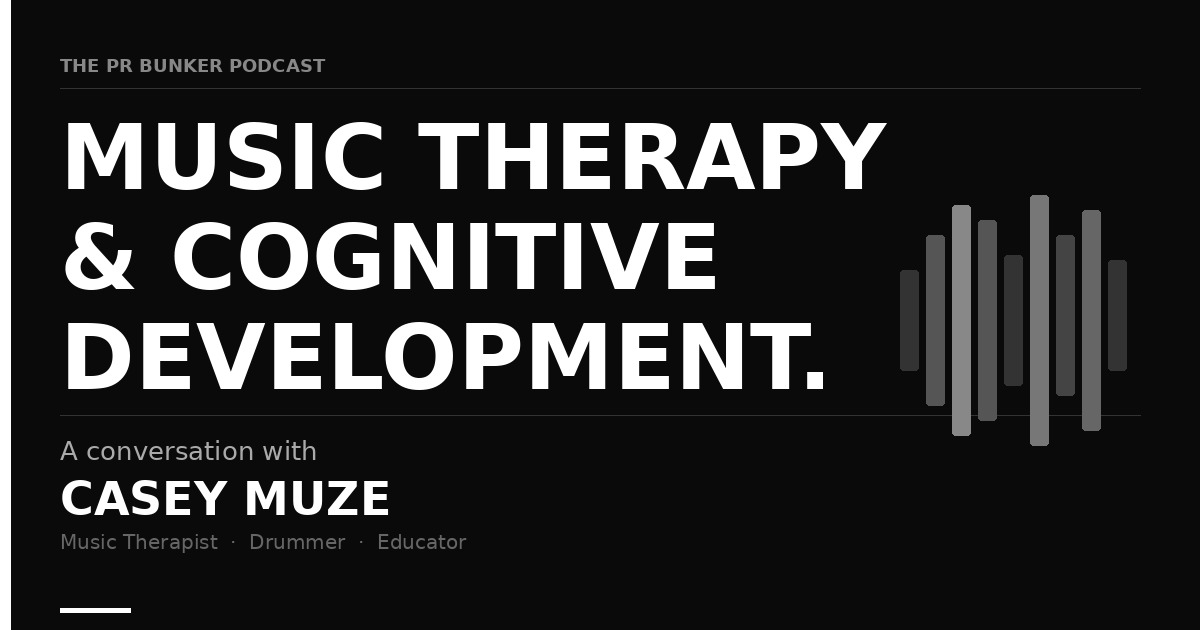
What happens when a drummer discovers that music doesn't just move people — it heals them?
That's the question at the heart of this conversation with Casey Muze, a music therapist whose journey from the drum kit to the clinical setting is as compelling as the work he now does every day.
Casey joins Don Martelli on The PR Bunker Podcast to talk about the science and soul behind music therapy — and why more people should be paying attention to it.
Casey's path wasn't a straight line. He came up as a musician, drawn to rhythm and performance. But over time, he found himself more interested in what music could do for people than what it could do for a crowd. That curiosity eventually led him to music therapy — a clinical discipline that uses music to address physical, emotional, cognitive, and social needs.
The field is more rigorous than many people realize. Board-certified music therapists complete specialized training and work across a wide range of settings — hospitals, schools, mental health clinics, hospice, and private practice. Casey works primarily with families, bringing music-based interventions into spaces where traditional talk therapy often falls short.
One of the most striking parts of this conversation is Casey's explanation of why music is uniquely effective at reaching people — especially those who struggle with verbal communication or emotional regulation.
Music engages multiple regions of the brain simultaneously. Rhythm activates motor systems. Melody and harmony trigger emotional processing. Lyrics engage language centers. That multi-system engagement is what makes music such a powerful therapeutic tool — it creates pathways that other modalities simply don't.
For children with developmental challenges, trauma histories, or anxiety disorders, music therapy can create a safe, non-threatening entry point into emotional work that might otherwise be inaccessible. Casey describes working with families and watching music become the bridge — between a child and their caregiver, between a feeling and a word, between dysregulation and calm.
Casey is also doing important work in trauma education — helping parents, educators, and clinicians understand the neuroscience of trauma and how music-based approaches can support recovery and resilience. He talks openly about the gap between what research shows and what most people actually know, and his commitment to closing that gap.
He also gives a preview of a book he's working on — one that promises to make these ideas accessible to a much broader audience.
Listen to The PR Bunker Podcast on Apple Podcasts, Spotify, and YouTube. Have a story worth telling? Apply to be a guest on the show.

Have a project, campaign, or comms challenge in mind?
Want to be a guest on the PR Bunker podcast?
Reach out and let’s talk.


